
Kings County Sex Offender Checks
The New York State Sex Offender Registry is the official starting point for Kings County. The Division of Criminal Justice Services, or DCJS, maintains it under the Sex Offender Registration Act. New York courts assign risk levels after a hearing. That level controls what the public can see and which search channel applies. The online directory lists Level 2 and Level 3 registrants. It does not list every person required to register.
Start with the question you need to answer. Use the online directory for a Level 2 or Level 3 name, Kings County, or ZIP search. Call the toll-free registry line if the person may be Level 1 or is not yet classified. Use NY-ALERT for notice of a listed person's move into or out of a selected area. Contact an NYPD precinct if a Brooklyn address appears wrong or a person may not be complying. These routes complement one another.
The official DCJS registry overview shows the state search and alert choices.
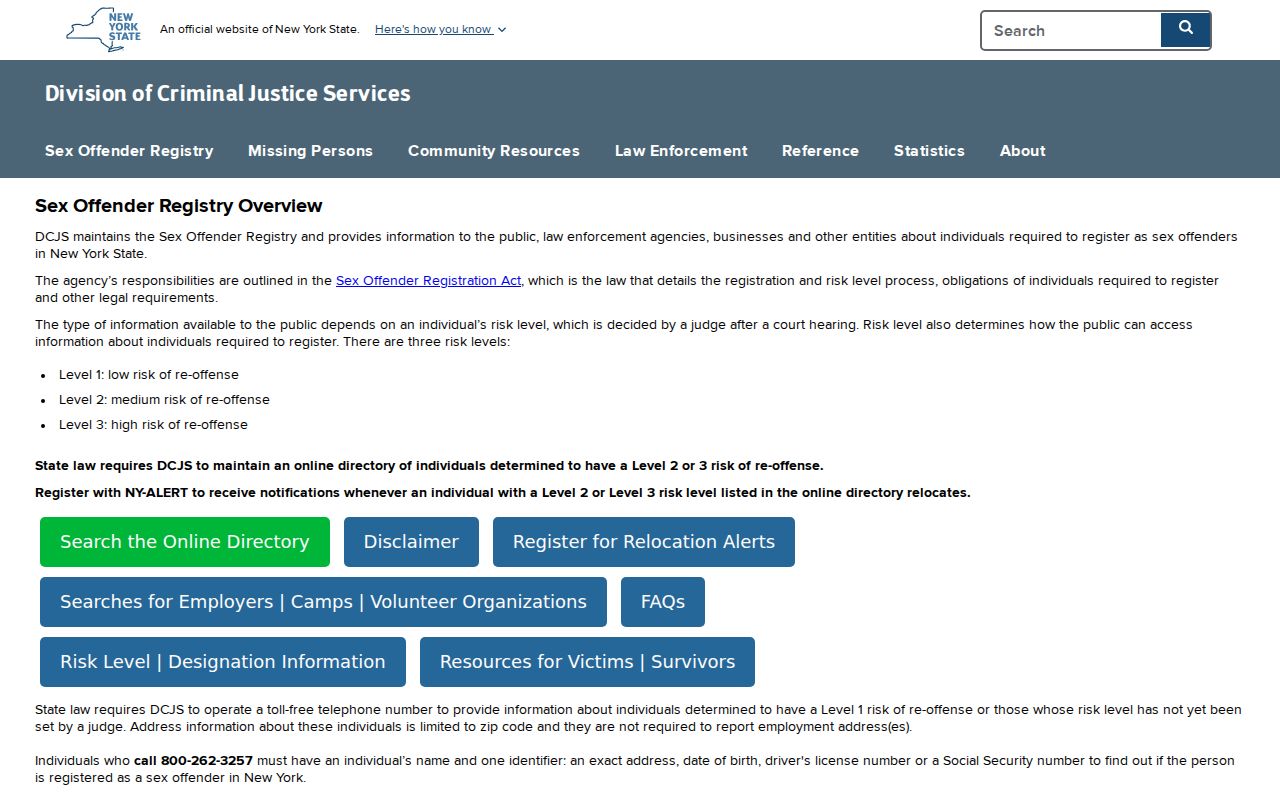
That overview is useful because it keeps the public directory, phone route, alerts, and registry contact information in one official place.
Kings County Level 1 Registry Calls
Level 1 is the low-risk category, but those records are not placed in New York's open online directory. An adult caller must use the DCJS toll-free information line at 800-262-3257. The line operates weekdays from 8 a.m. to 4 p.m., except holidays. There is no fee, and DCJS does not accept this type of search by email.
Be ready to give your own name, address, and phone number. You must also provide the subject's name and one exact identifier: an address, date of birth, driver-license number, or Social Security number. This is not a broad browse by neighborhood. The exact fact helps DCJS distinguish one person from another and prevents a vague name inquiry from being treated as a match.
Not-yet-classified registrant information also follows the telephone route. If the directory has no result, do not infer that no registry record exists. The person may be Level 1, awaiting classification, incarcerated under a filtered category, listed under a different valid name, or outside the county value used in the search.
New York State Sex Offender Registry Searches
The DCJS Level 2 and Level 3 directory is free. Choose one main criterion. A Kings County search returns public entries categorized under Kings, while a surname or ZIP search answers a narrower question. CAPTCHA controls limit automated use. Three custody checkboxes can exclude people in local or state correctional custody, ICE custody, or federal custody in New York. Leave a box clear when custody status is part of the question.
- Open the official directory and review its use terms before searching.
- Enter a last name, select Kings under County, or enter a ZIP Code. Use only one primary criterion.
- Set the custody exclusions with care, complete the CAPTCHA, and submit the search.
- Open a likely record and compare the profile, photo, aliases, offense facts, and reported address. Do not rely on a name alone.
| Field | Type | Required | Options or notes |
|---|---|---|---|
| Last Name | Text | One of three | Search by surname |
| County | Dropdown | One of three | Select Kings, not Brooklyn |
| ZIP Code | Text | One of three | Search residents categorized in that ZIP |
| Custody exclusions | Checkboxes | No | Local or state, ICE, and federal custody categories |
| CAPTCHA | Challenge | Yes | Required automated-access control |
| Search / Clear | Buttons | Not applicable | Submit or reset the form |
The official Level 2 and Level 3 search interface shows the exact county and custody controls.
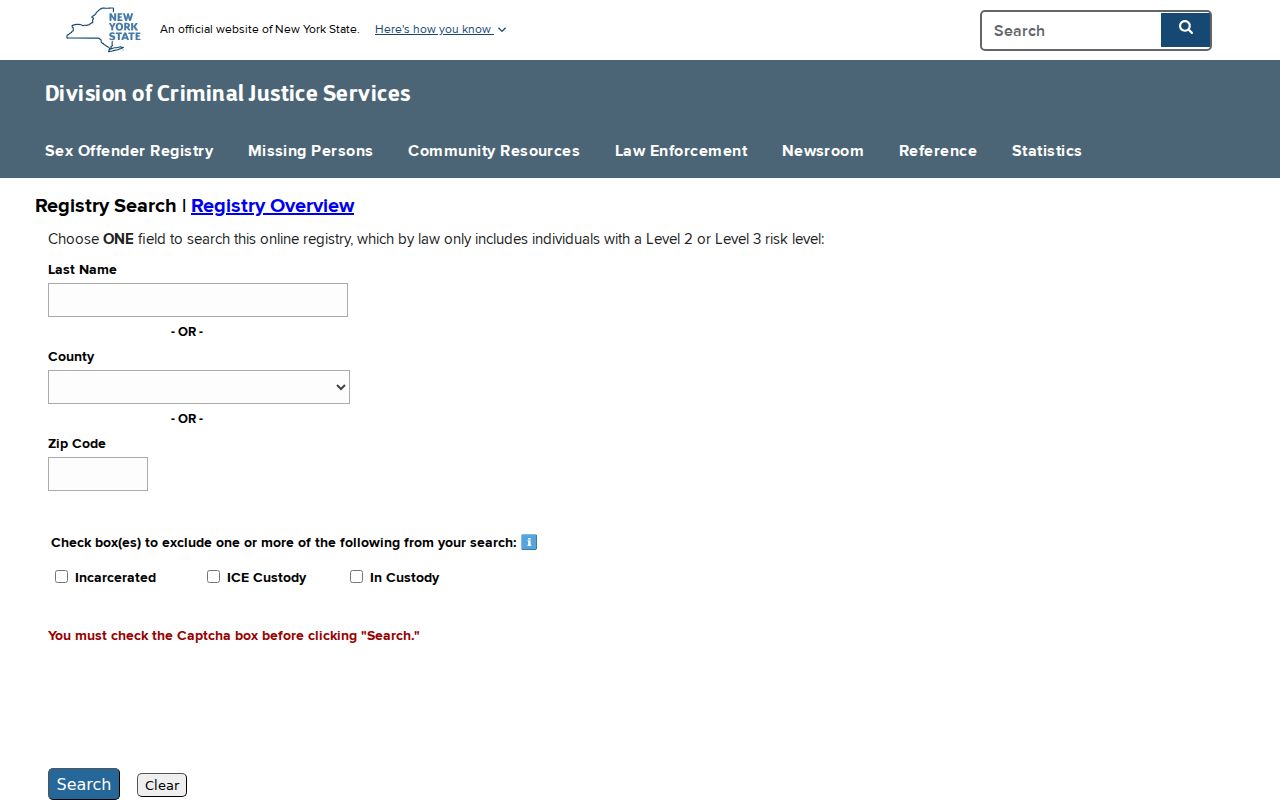
The form makes a key Brooklyn detail plain: county-based searches use the value Kings even though local addresses say Brooklyn.
Kings County Registry Alerts, Not Maps
New York offers no state radius or map search. That matters for a person who wants notice around a home, school route, or other place rather than a list for all of Kings County. The official substitute is NY-ALERT. It can send free email, text, fax, or phone notifications when a listed Level 2 or Level 3 person moves into or out of selected communities.
A subscriber may choose up to three areas or locations. The choices can use county, municipality, ZIP, or specified address combinations. The alert is a move-notification service, not a live map and not a promise that every registrant is shown. Level 1 records remain outside the open directory. A location alert also depends on the address data reported to DCJS.
For Kings County, select Kings where the service asks for a county. Use Brooklyn where a municipality or mailing-place field calls for it. This small naming distinction avoids an empty or misdirected alert setup.
Registry Profiles: What They Show
A public profile can contain much more than an address. DCJS may display identity, physical-description, offense, vehicle, work, school, and supervision facts received from reporting sources. Fields vary by record. The directory warns that DCJS cannot guarantee every item is complete or current, so a profile should be read as an official public record with stated limits.
| Name and aliases | Reported legal name and other names tied to the registry record |
|---|---|
| Photos and description | Available images plus age or date-of-birth information, sex, race, height, weight, eyes, and distinctive marks as allowed |
| Residence and work | Exact public Level 2 or Level 3 residence and a work address where the statute calls for it |
| Vehicles | Reported make, model, and license plate |
| Offense record | Registerable current or prior offenses, conviction date, sentence, and supervision information |
| Conduct details | Modus operandi and victim type where DCJS provides them |
| Education and supervision | Higher-education relationship, special conditions, and supervising agency when reported |
Match several fields before drawing a conclusion. Similar names are common in a county as large as Kings, and an old photo or recent move can make one field less useful than the full profile.
Kings County Registry and NSOPW Limits
The National Sex Offender Public Website, or NSOPW, adds a cross-state name search. It is maintained by the U.S. Department of Justice and draws from participating jurisdiction registries. Use it when a person may have lived outside New York or when a name search needs a wider geographic reach. It supplements the DCJS search; it does not replace New York's phone route for Level 1 information.
There is a specific New York limit. NSOPW cannot provide geographic-coordinate searching for this state because New York does not supply coordinates. A user cannot treat the absence of a map pin or radius result as proof that no Kings County registrant is nearby. Use a name search through NSOPW, the county or ZIP controls in DCJS, and NY-ALERT for move notices.
The official national search displays the multistate starting point.
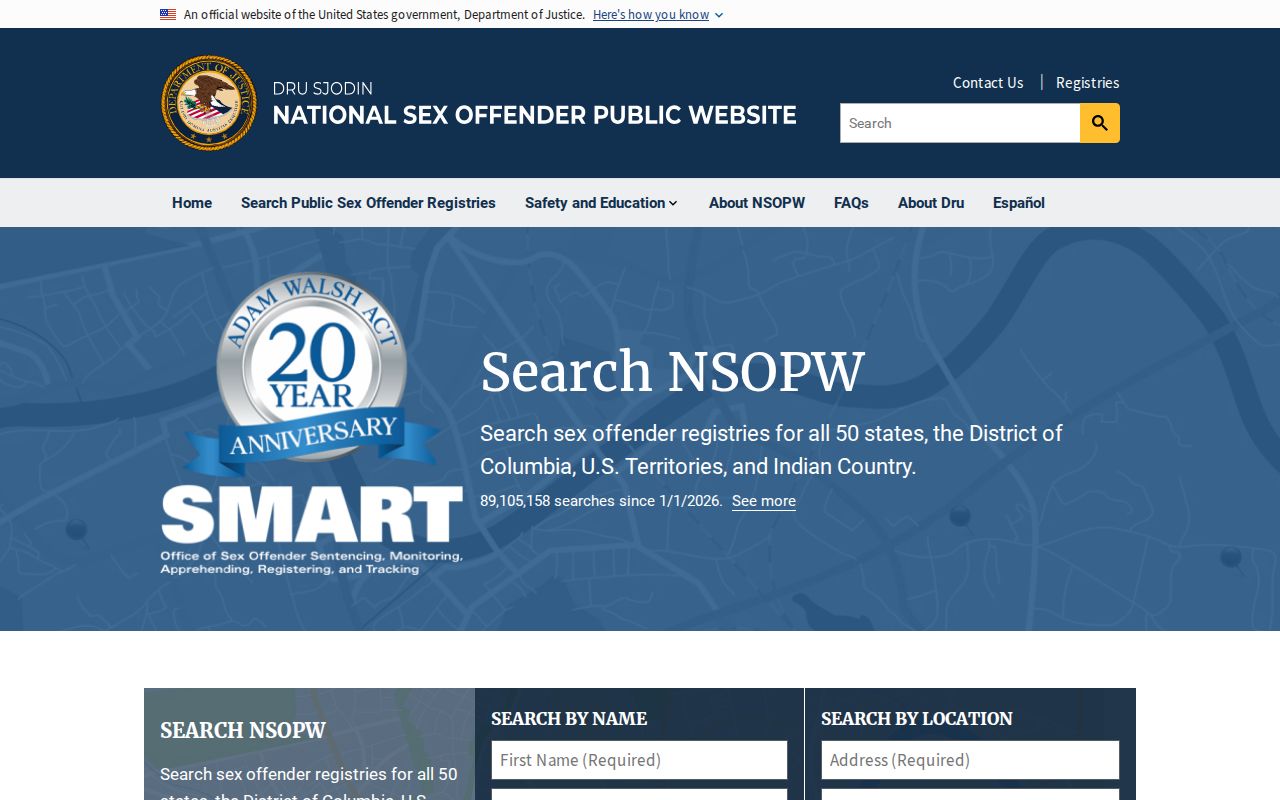
Its national reach is useful, but the New York coordinate gap makes the state directory and alert service essential local companions.
Registration Levels and Duties in New York
New York's court-assigned risk levels are not the federal SORNA tier labels. A judge assigns Level 1, 2, or 3 after a risk-level hearing. A separate designation, such as sexual predator, sexually violent offender, or predicate sex offender, can change the registration term. All registrants verify each year. Level 3 registrants and sexual predators verify their addresses in person every 90 days.
| Judicial category | Meaning | Registration term | Public route and key duty |
|---|---|---|---|
| Level 1, no designation | Low risk | 20 years | Phone route; annual verification |
| Level 1 with designation | Low risk plus statutory designation | Life | Phone route; annual verification, with 90-day in-person address checks for sexual predators |
| Level 2 | Moderate risk | Life; an undesignated person may petition after 30 years | Online directory; annual verification |
| Level 3 | High risk or threat to public safety | Life | Online directory; address verified in person every 90 days |
Address changes must be reported within 10 days. Photos update every three years for Levels 1 and 2 and each year for Level 3. Level 2 and Level 3 registrants may seek a risk-level modification under Correction Law §168-o, so the level shown can change through a court process.
Kings County Registry Residency Rules
SORA does not create one blanket rule that bars every registrant from living within a set distance of a school, park, or child-care site. That common claim overstates New York law. Separate parole or probation terms may restrict some people under supervision, including certain limits involving a 1,000-foot distance from schools or child-care facilities.
Read the profile and supervision fields as they are presented. Do not infer an unlawful address merely from a map or a nearby landmark. The supervising agency, court order, and the person's actual status determine whether a special condition applies. For a safety concern about a Brooklyn address, contact the local NYPD precinct. Call 911 for an emergency.
Note: A registry address alone does not reveal every parole, probation, court, or family circumstance that may govern a specific person.
Correcting Kings County Registry Data
Wrong or stale address data should be routed to the office that can act on it. A local wrong-address or possible noncompliance concern goes to NYPD or the person's Brooklyn precinct. The DCJS registry office handles directory records and registry questions at 518-417-3384 or SORRequests@dcjs.ny.gov. Mail may be sent to DCJS Sex Offender Registry, 80 South Swan Street, 10th Floor, Albany, NY 12210.
Give the record name, the specific field that appears wrong, and the basis for the concern. Do not confront the person or publish private claims. A recent move may take time to reach the public entry, and DCJS relies on data from courts, supervision offices, and other reporting sources. Emergency threats belong with 911, not an email queue.
DCJS Sex Offender Registry
80 South Swan Street, 10th Floor
Albany, NY 12210
518-417-3384
SORRequests@dcjs.ny.gov
Using Registry Information Lawfully
Registry information supports public awareness and personal or family safety. It does not grant permission to threaten, follow, intimidate, or harass a registrant or anyone in that person's household. Share an urgent public-safety concern with law enforcement. Send a suspected data error through the registry or NYPD route instead of trying to enforce a registration duty yourself.
Correction Law Article 6-C contains New York's Sex Offender Registration Act. Section 168-q specifically addresses unlawful use of registry information and allows the attorney general, a district attorney, or an aggrieved person to seek an injunction.
Misuse warning: Correction Law §168-q provides an additional $500 to $1,000 fine for unlawful use and up to $1,000 for unauthorized removal or duplication of a police-office subdirectory. Harassment, threats, or other crimes may be prosecuted on their own terms.
Failure to register is also a serious offense. A first failure is generally a Class E felony, while a later failure is generally a Class D felony. Report suspected noncompliance to the NYPD. The registry search itself is an information tool, not a substitute for an official investigation.