
Brooklyn Criminal History Checks
A Brooklyn search starts by identifying the kind of record and its current stage. NYPD holds incident and arrest paperwork. New York City Criminal Court, Kings County, holds arraignment, misdemeanor, summons, and preliminary felony files. Kings County Supreme Court, Criminal Term, holds felony indictments. NYC Department of Correction tracks city custody. DCJS provides fingerprint-based review of one's own state rap sheet.
- Identify the Brooklyn precinct, date, location, and any complaint, arrest, docket, indictment, NYSID, or Book and Case number already known.
- Use the NYPD's specific report form or NYC OpenRecords for police-created material. Include the precinct even though production is centralized.
- Search WebCriminal under Kings and the right court. Call the clerk when a concluded file or certified outcome does not appear.
- Use NYC DOC after arraignment for current custody, bail, facility, and court details. Call 311 while a person is still in police custody.
- Use DCJS Personal Record Review when the purpose is to inspect or correct your own fingerprint-linked New York history.
Keep the products separate. A police report describes an incident or arrest. A custody entry tracks detention. A court file records charges and the disposition. A DCJS rap sheet connects fingerprint-supported arrest cycles with outcomes reported by courts and prosecutors.
Brooklyn and Kings Records Geography
Brooklyn and Kings County are coterminous. They describe the same land, but the names do different work in record systems. Court and registry county menus use Kings. Street addresses and borough references use Brooklyn. New York City, not a standalone Brooklyn city government, performs police, correction, and many records functions.
This structure dates to Brooklyn's consolidation into New York City in 1898. It explains why a request cannot be sent to a Brooklyn city clerk, Brooklyn sheriff, or Brooklyn police headquarters for criminal files. Those offices do not serve the roles assumed by a generic city records process.
The Census Bureau's Kings County QuickFacts presents the borough and county as the same search geography.
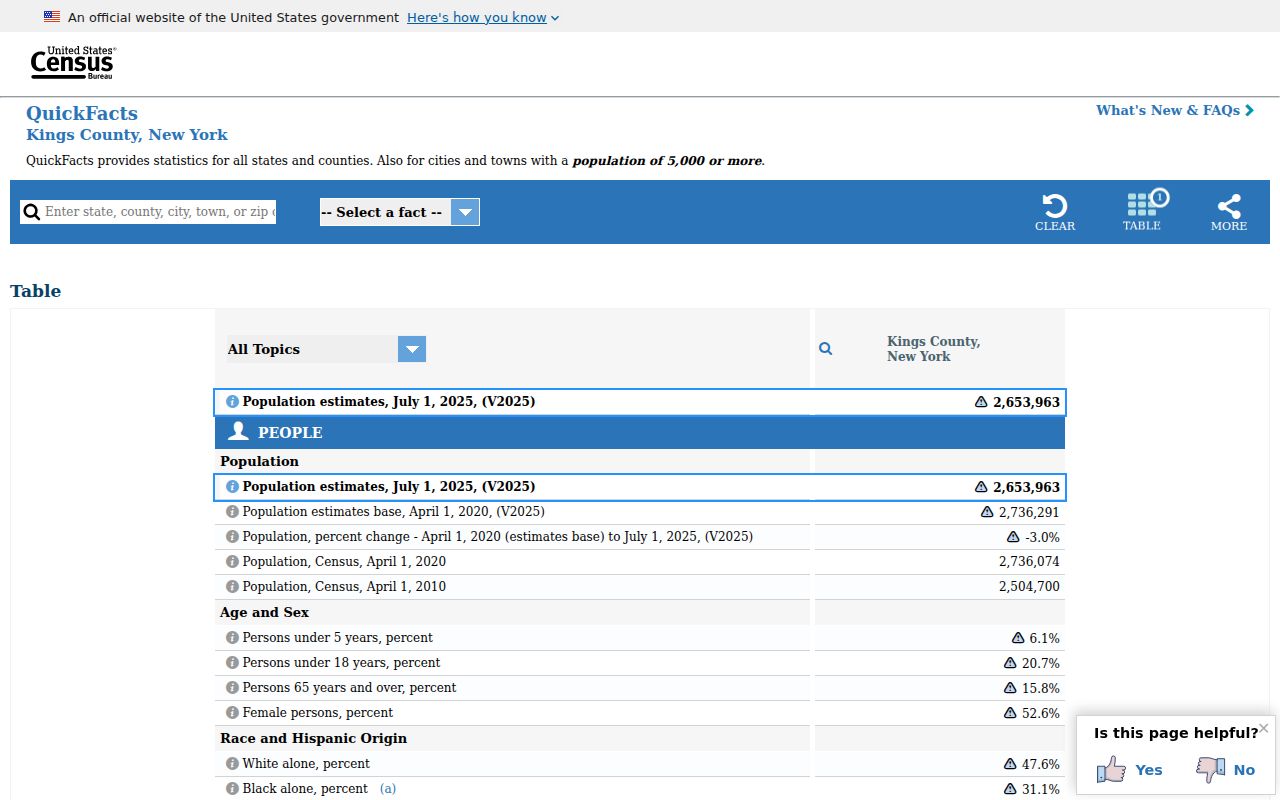
The shared geography is the reason a Brooklyn mailing label and a Kings court or registry label can both be correct for one person or event.
Records at the Brooklyn Police Department
There is no separate Brooklyn Police Department. The New York City Police Department patrols Brooklyn through 23 precincts plus Housing and Transit commands, divided between Patrol Borough Brooklyn North and Brooklyn South. Local precinct staff take reports and handle neighborhood policing, but the NYPD Criminal Records Unit and Legal Bureau manage the central release routes.
Complaint Report Verification and Aided Reports are free. Use the official NYPD request forms online or by mail. Broader arrest paperwork, 911 or SPRINT material, body-camera video, and other agency records go through NYC OpenRecords or the NYPD FOIL process. Complaint verifications return by mail or email. The Criminal Records Unit at One Police Plaza is not open for public pickup.
A useful request gives the report type, date, time, exact place, precinct or command, subject or complainant name as permitted, and complaint or arrest number. It should ask for an existing record, not require NYPD to create a new explanation or analysis.
Route Brooklyn Police Records by Precinct
Brooklyn's precinct is a search key even though records are produced through a citywide unit. The borough has the 60th, 61st, 62nd, 63rd, 66th, 67th, 68th, 69th, 70th, 71st, 72nd, 73rd, 75th, 76th, 77th, 78th, 79th, 81st, 83rd, 84th, 88th, 90th, and 94th Precincts. A street may sit near a command boundary, so do not guess from a neighborhood name.
Use the NYPD precinct directory and locator before submitting a Brooklyn request. Then put that command, the event location, and the narrow date range in the form. If the event occurred on MTA, Port Authority, or CUNY property, another agency may be the custodian even though the place is in Brooklyn.
When NYPD responds that the facts are not enough, add the complaint or arrest number, full intersection, exact time, and known names rather than filing the same broad request again. For a denial, FOIL supplies an appeal route. It does not override sealing, active-investigation, privacy, witness-safety, or law-enforcement-method limits.
Booking and Arrest Records in Brooklyn
NYPD creates the arrest and central-booking records. A person may remain in a stationhouse or booking process before appearing in the NYC DOC lookup. During roughly the first 24 to 48 hours, call 311 or 212-639-9675 and give the correct name and identifying facts. The arrested-person finder can confirm police custody and the likely arraignment site.
After arraignment and DOC intake, use the NYC DOC Person in Custody Lookup. Search by NYSID or Book and Case Number when possible, or by name. A result may show charges, court date and location, holding facility, bail or bond, release date, mailing address, NYSID, and Book and Case Number. It is a custody record, not proof of guilt and not a full Brooklyn arrest history.
There is no official NYPD daily name-based Brooklyn arrest blotter. NYC Open Data publishes arrest data for public analysis, but that dataset is not a fingerprint-matched rap sheet. For the report itself, use NYPD records channels. For filed charges or the final result, move to the court record.
Brooklyn Arrests Enter Citywide Custody
Brooklyn does not operate a county sheriff jail. NYC Department of Correction houses people remanded by city courts or serving city sentences, and a person arrested in Brooklyn may be held elsewhere in the city system. Most commonly, current facilities are on Rikers Island. Never infer a bed location from the arrest borough.
The former detention complex at 275 Atlantic Avenue is not an operating jail. A new 15-story Brooklyn Borough-Based Jail is under construction at that site. It topped out in April 2026 and is scheduled for substantial completion in spring 2029. Until it opens and custody operations change, the live DOC result remains the source for the actual facility.
Booking path: Brooklyn NYPD arrest › central booking and fingerprints › Kings County arraignment › NYC DOC custody when ordered.
The planned borough jail is a future system change, not a current lookup destination. A stale address list that sends families to Atlantic Avenue would waste a trip.
The Brooklyn Municipal Court File
Brooklyn has no municipal court. Criminal matters are heard in state courts that operate within New York City's court structure. New York City Criminal Court, Kings County, at 120 Schermerhorn Street handles arraignments, misdemeanors, violations, summons matters, Desk Appearance Tickets, and preliminary felony proceedings. Felony indictments move to Kings County Supreme Court, Criminal Term, at 320 Jay Street.
| Municipal court | None; do not search for a separate Brooklyn city-court docket |
|---|---|
| Lower criminal court | New York City Criminal Court, Kings County |
| Felony indictment court | Kings County Supreme Court, Criminal Term |
| Online discovery route | WebCriminal under Kings and the correct court |
| Concluded or certified record | Call the sentencing or file-holding court clerk; request a Certificate of Disposition when proof of outcome is needed |
| Common identifiers | Kings or KN docket context in lower court, then an indictment number in Supreme Court |
A no-result screen does not establish that no case exists. WebCriminal emphasizes future appearances. Concluded, sealed, or older matters may not appear, and a felony may have moved from a Criminal Court docket to a Supreme Court indictment number.
Brooklyn Criminal Records Justice Cluster
Downtown Brooklyn places several record offices close together, but their files remain distinct. Criminal Court is at 120 Schermerhorn Street. Supreme Criminal Term is at 320 Jay Street. The Kings County District Attorney is at 350 Jay Street. The federal courthouse for the Eastern District of New York is at 225 Cadman Plaza East.
Kings County Criminal Court
120 Schermerhorn Street
Brooklyn, NY 11201
347-404-9400
Clerk hours: weekdays, 9 a.m. to 5 p.m., except holidays
Supreme Court, Criminal Term
320 Jay Street
Brooklyn, NY 11201
347-296-1076
Call before requesting a physical or certified file
The short distance does not merge the custodians. Order a Certificate of Disposition from the sentencing court, not the DA or DCJS. Search federal cases through PACER, not WebCriminal. Ask court staff, rather than eCourts technical support, to correct data entered by the court.
How Brooklyn Records Reach the County
An NYPD arrest begins as city police paperwork. Fingerprints and identifying data from a fingerprintable arrest go to the New York State Division of Criminal Justice Services. The person proceeds to Kings County Criminal Court for arraignment. A misdemeanor generally remains there, while an indicted felony moves to Kings County Supreme Court, Criminal Term.
Record flow: NYPD in Brooklyn › Kings County Criminal Court or Supreme Court › New York State Division of Criminal Justice Services.
Prosecutors and courts report charges and dispositions back to DCJS. NYC DOC separately updates custody, bail, court, facility, and release data while a person is in city custody. This is why one Brooklyn event can create police, booking, court, and rap-sheet records that update on different schedules.
For broader treatment of that split, the Kings County criminal history overview compares the county, city, state, and federal channels. A Brooklyn search should stay with the most direct custodian first.
Kings Labels in Brooklyn Record Searches
Small label choices can decide whether a local search works. Choose Kings in WebCriminal's County field. Use the court name that fits the case stage. A lower-court docket may carry a KN context, while an indicted felony uses a Supreme Court indictment number. In the state sex offender directory, select Kings rather than looking for Brooklyn in the county list.
Use Brooklyn in the mailing address, precinct locator, and borough field. Use New York City Police Department as the agency in OpenRecords. Use NYC Department of Correction for present city custody, not a Kings County jail. These are not word games. Each value routes the request to the system's own geography.
- Kings
- The county value used by criminal courts and the state registry.
- Brooklyn
- The borough and mailing-place name used for addresses, precincts, and local context.
- KN
- A Kings County context found in New York City criminal docket identifiers.
- Book and Case Number
- The NYC DOC custody identifier, not a court docket.
- NYSID
- The fingerprint-linked New York State identification number used across justice systems.
Note: Preserve punctuation and the full identifier from a court or custody paper before searching a second system.
Brooklyn Record Access Rules
New York Freedom of Information Law applies to executive agencies such as NYPD and NYC DOC, but court files use judiciary and clerk access rules. FOIL begins with access and then permits withholding or redaction for statutory confidentiality, personal privacy, active cases, fair-trial rights, confidential sources, non-routine methods, and safety. It does not open sealed court or DCJS rap-sheet records.
An agency generally has five business days to grant, deny, or acknowledge a FOIL request and give an approximate response date. A requester may appeal an express or constructive denial within 30 days. Standard paper copies may cost up to 25 cents per page, while some electronic production may carry actual statutory reproduction costs.
Key statutes:
Public Officers Law Article 6 sets New York's FOIL access, exemption, timing, fee, and appeal framework.
CPL 160.50 restricts qualifying arrest, court, police, and prosecutor records after a favorable termination.
CPL 160.57 creates phased Clean Slate automatic sealing for eligible convictions.
Ask for a narrow existing record. Include the Brooklyn precinct, dates, site, and identifiers. For a court document, contact the clerk instead of sending a FOIL request to NYPD.
Read Brooklyn Criminal Records by Precinct
Brooklyn covers 69.4 land square miles and had 2,736,074 residents in the 2020 Census, with a 2025 estimate of 2,653,963. Boroughwide totals are too coarse to describe a single neighborhood or predict a person's conduct. The useful public context comes from NYPD precinct and patrol-borough reports with a clear period and year.
The official CompStat hub separates Brooklyn North, Brooklyn South, and precinct reports. NYC Open Data supplies row-level arrest datasets with methods and publication limits. Neither source is a name-based criminal history search, and neither turns an arrest count into proof of guilt.
Use these sources to understand workload, geography, and trends. Use a police report, court file, or subject-only DCJS review to answer a record question. That distinction keeps public statistics from being mistaken for an individual record.