
Kings County Criminal History Checks
A useful Kings County search begins with the question the record must answer. New York eCourts and WebCriminal help locate pending criminal cases and future appearances. The court clerk supplies older files and certified dispositions. NYC Department of Correction shows current city custody after intake, while NYPD provides police reports through its own request process. For an official fingerprint-linked review of your own New York history, the correct source is DCJS rather than a public name search.
Gather the full court spelling of the name, date of birth when the system permits it, arrest date, precinct, and every known number. A Kings docket, indictment number, NYSID, or Book and Case Number can separate two people with similar names. Then preserve the exact court, case status, top charge, and next date shown. A screen result is a lead, not a substitute for the record held by the clerk or agency.
- Choose court, custody, police, or personal rap-sheet records based on the fact you need.
- Search with the strongest official identifier and the spelling used in the source system.
- Confirm that Kings is selected when a county field appears, even when the mailing address says Brooklyn.
- Contact the record-holding clerk or agency when a result is missing, old, sealed, or unclear.
- Order a certificate or personal Record Review when formal proof or correction is needed.
Kings County Records Cross Three Systems
Kings County has no conventional county sheriff jail, elected criminal-records clerk, or single records building. The New York City Sheriff mainly performs civil enforcement and does not hold NYPD arrest reports or NYC DOC booking data. Police and custody records are city records. Criminal cases are state court records. Fingerprint-supported rap sheets belong to the New York State Division of Criminal Justice Services.
This division explains why one search can be blank while another is not. An arrest report describes police action. A booking entry reports custody. A court file follows charges, appearances, pleas, rulings, and disposition. A DCJS rap sheet links fingerprint-supported arrest cycles with outcomes reported back by prosecutors and courts. Federal cases in Brooklyn form a fourth layer and are searched through PACER, not New York court tools.
Note: Brooklyn and Kings County are the same search geography, but portal labels may use either name.
Official Background Checks in New York
The DCJS Personal Record Review is the official route for a person to inspect their own fingerprint-matched state history. An attorney may also request it for the subject. New York does not offer the public a DCJS name-search portal for another person's rap sheet. IdentoGO by IDEMIA collects the fingerprints. Service code 15464Z requests a suppressed response, while 15465F requests an unsuppressed response that can show material hidden from ordinary public results.
The current published fee is $17.50. DCJS states that a mailed response generally takes about three to four weeks and is not available for pickup. A fee-waiver packet can be requested from the Records Review Unit. OCA Criminal History Record Search is different. It is a $95 public court-record search using an exact name and date of birth, not fingerprints. It can report public pending and conviction records, but excludes sealed matters and has stated local-court coverage limits.
The official DCJS instructions show how the fingerprint channel works. The DCJS Record Review source is captured below.
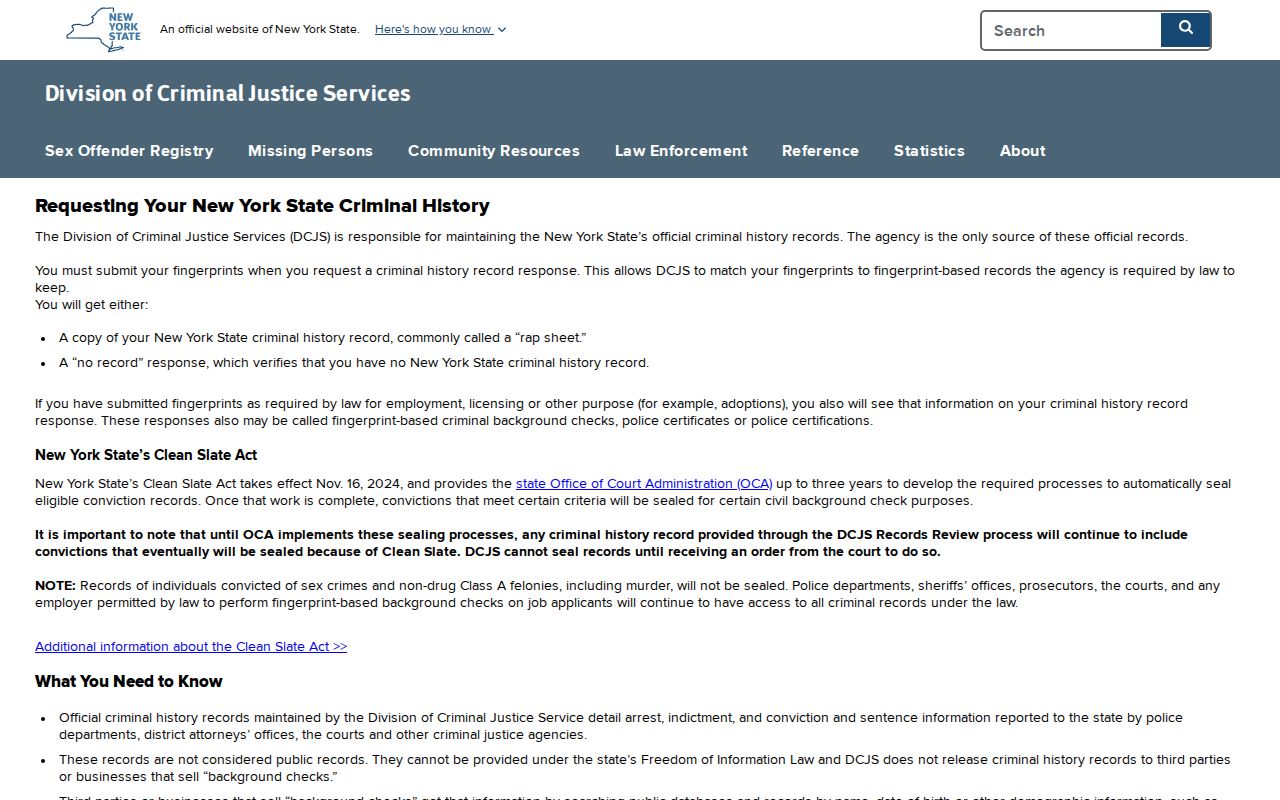
For Kings County residents auditing their own record, this route provides the identity match that a name-based court search cannot.
Kings County Court Records Change Buildings
A local criminal case often starts at Kings County Criminal Court, 120 Schermerhorn Street. That court handles arraignments, misdemeanors, violations, summons matters, Desk Appearance Tickets, and preliminary felony proceedings. A felony complaint may later move after grand-jury action to Kings County Supreme Court, Criminal Term, at 320 Jay Street. At that point, an indictment number can become more useful than the first Criminal Court docket.
The path is simple to state but easy to miss: arrest and complaint, arraignment at Schermerhorn, grand-jury review when applicable, indictment, Supreme Court proceedings at Jay Street, then disposition and sentence. A docket beginning with KN points to Kings in NYC systems. The sentencing court, not DCJS, issues a Certificate of Disposition. Readers who need the full court workflow can use the Kings County court case lookup.
Kings Criminal Court
120 Schermerhorn Street
Brooklyn, NY 11201
347-404-9400
Clerk and DAT hours: weekdays, 9 a.m. to 5 p.m.
Supreme Criminal Term
320 Jay Street
Brooklyn, NY 11201
347-296-1076
Call the clerk before seeking an older or certified file.
Kinds of Criminal Records
Kings County criminal history is assembled from distinct records made at different stages. An incident report may exist without an arrest. An arrest report reflects probable cause and the charges selected by police at that time. NYC DOC then creates a custody record if the person enters city jail custody. Court staff maintain the docket and the filed charges, while DCJS receives fingerprint and disposition data for the state rap sheet.
These sources should not be treated as interchangeable. The most reliable route is to match the record to its custodian and then compare dates and identifiers across systems.
- Police records: NYPD complaint, aided, incident, and arrest paperwork comes through the Criminal Records Unit or FOIL.
- Custody records: NYC DOC reports current city custody, bail, court, and release information.
- Court records: Criminal Court and Supreme Court files show filed counts, events, outcomes, and sentences.
- State histories: DCJS connects fingerprinted arrest cycles with reported court dispositions for subject review.
- Supervision and registry records: NYC Probation, DOCCS, and DCJS each maintain a separate part of the record system.
Kings County Custody Records Leave Brooklyn
A Brooklyn arrest does not guarantee a Brooklyn jail address. NYC DOC operates the city jail system, and a person can be housed elsewhere, most often in the Rikers Island complex. The former detention complex at 275 Atlantic Avenue is not an operating jail. A new borough jail is under construction, but official plans place substantial completion in spring 2029. Until that facility opens, use the live custody result rather than guessing from the arrest borough.
The NYC DOC Person in Custody Lookup works best with an NYSID or Book and Case Number. Name search is available after DOC intake. During the first 24 to 48 hours, police custody may not appear there, so 311 or 212-639-9675 is the better first call. State prison and parole require DOCCS lookup tools; federal custody requires the BOP locator.
| Question | Kings County channel | Best key |
|---|---|---|
| Still in police processing? | 311 arrested-person service | Full name and identifying facts |
| In NYC jail custody? | NYC DOC lookup | NYSID or Book and Case Number |
| Serving a state term? | DOCCS Incarcerated Lookup | DIN, NYSID, or name |
| Federal custody? | BOP Inmate Locator | Register number or name |
Kings County Criminal Records: What They Contain
A DCJS response organizes information around identity and arrest cycles. Each cycle begins when fingerprints create or match an event. Police charges, prosecution tracking, court identifiers, dispositions, and sentence details can then attach to it as agencies report updates. A court certificate remains the best source for proving the disposition of one case, while a booking screen is limited to custody.
| Name and identifiers | Names, aliases, date of birth, NYSID, and fingerprint-linked control data when applicable. |
|---|---|
| Arrest data | Arrest date, agency, incident cycle, and charges recorded when custody began. |
| Court data | Court name, docket or indictment number, filed charges, appearances, and status. |
| Disposition | The result for each count, including conviction, dismissal, or acquittal when reported. |
| Sentence | Jail, prison, probation, fine, or other sentence terms tied to the judgment. |
| Restrictions | Sealing or suppression notations visible only when the requester is entitled to see them. |
Missing or mismatched outcomes can occur when agencies use different identifiers or a disposition has not reached DCJS. That gap calls for a court certificate and the DCJS challenge process, not an assumption about the result.
Kings County Programs Alter Case Records
The Kings County District Attorney uses named alternatives that can change how a case moves and what disposition follows. Its Alternative Programs Bureau screens matters for Brooklyn Treatment Court, felony and misdemeanor veterans tracks, STEP, DTAP, and other alternatives. Justice 2020 emphasizes diversion and community-based resolutions. Those programs do not erase a court file on their own, but they can affect pleas, adjournments, treatment conditions, and final outcomes.
The Justice 2020 initiative is shown in the official capture below.
A searcher should read the court disposition, not infer an outcome from the arrest charge or a program name. The DA's Post-Conviction Justice Bureau also combines conviction review, sealing, parole, and clemency work, while the sentencing court remains the source for the case record.
New York Public Access Laws
The New York Freedom of Information Law, or FOIL, begins with access to agency records but permits withholding and redaction for privacy, active investigations, fair-trial rights, confidential sources, safety, and records made confidential by another statute. Police and correction requests use agency FOIL channels. Court records follow judiciary access procedures through the clerk, and DCJS rap sheets are not public under FOIL.
An agency has five business days to grant, deny, or acknowledge a request and state an approximate response date. A requester may appeal an express or constructive denial within 30 days. Standard paper copies up to 9 by 14 inches may cost up to 25 cents per page, while qualifying electronic reproduction can be charged at actual statutory cost.
Key New York laws:
Public Officers Law Article 6 sets FOIL access, exemptions, response duties, fees, and appeals.
CPL 160.50 seals qualifying cases after a favorable termination.
CPL 160.57 establishes phased Clean Slate automatic sealing.
CPL 160.59 permits court applications to seal certain older convictions.
Correcting Kings County Criminal Records
When a personal DCJS history lacks a Kings County disposition, first obtain a Certificate of Disposition from the court that sentenced or ended the case. The certificate is concise proof of the charge, outcome, conviction date when applicable, and sentence. In New York City, the published fee is $10. Bring photo identification and the docket number. A sealed-case request may require the subject's identification or notarized authority for an agent.
Next, compare the court certificate with the unsuppressed DCJS Personal Record Review. Follow the challenge instructions included with the response and submit the certificate or signed sealing order as proof. Court staff correct data they entered in WebCriminal. eCourts technical support and DCJS cannot rewrite a local court docket. That split in responsibility is one of the most important Kings County record rules.
- Docket number
- The lower criminal court identifier, often carrying a Kings or KN context.
- Indictment number
- The Supreme Court identifier used after grand-jury charges.
- NYSID
- The state fingerprint-linked identification number used across criminal justice and custody systems.
- Disposition
- The court result for a charge or case, such as conviction, dismissal, or acquittal.
Restricted, Sealed & Expunged Records
Record sealing is the main New York term. CPL 160.50 generally seals qualifying favorable terminations, while CPL 160.55 covers specified violation and traffic-infraction outcomes. CPL 160.59 allows an application to seal up to two eligible convictions, no more than one of them a felony, after at least ten crime-free years measured from conviction or release from incarceration. Pending cases and later convictions affect eligibility, and the statute excludes listed serious offenses.
Clean Slate took effect on November 16, 2024. The Unified Court System has until November 16, 2027 to complete automatic sealing under CPL 160.57. The waiting period alone does not prove that a Kings County record is already sealed. Court status and the official implementation process control. Some cannabis convictions were expunged by statute, but that narrower remedy should not be used as a label for every New York record restriction.
The courts publish the current implementation status. The New York Clean Slate source appears below.
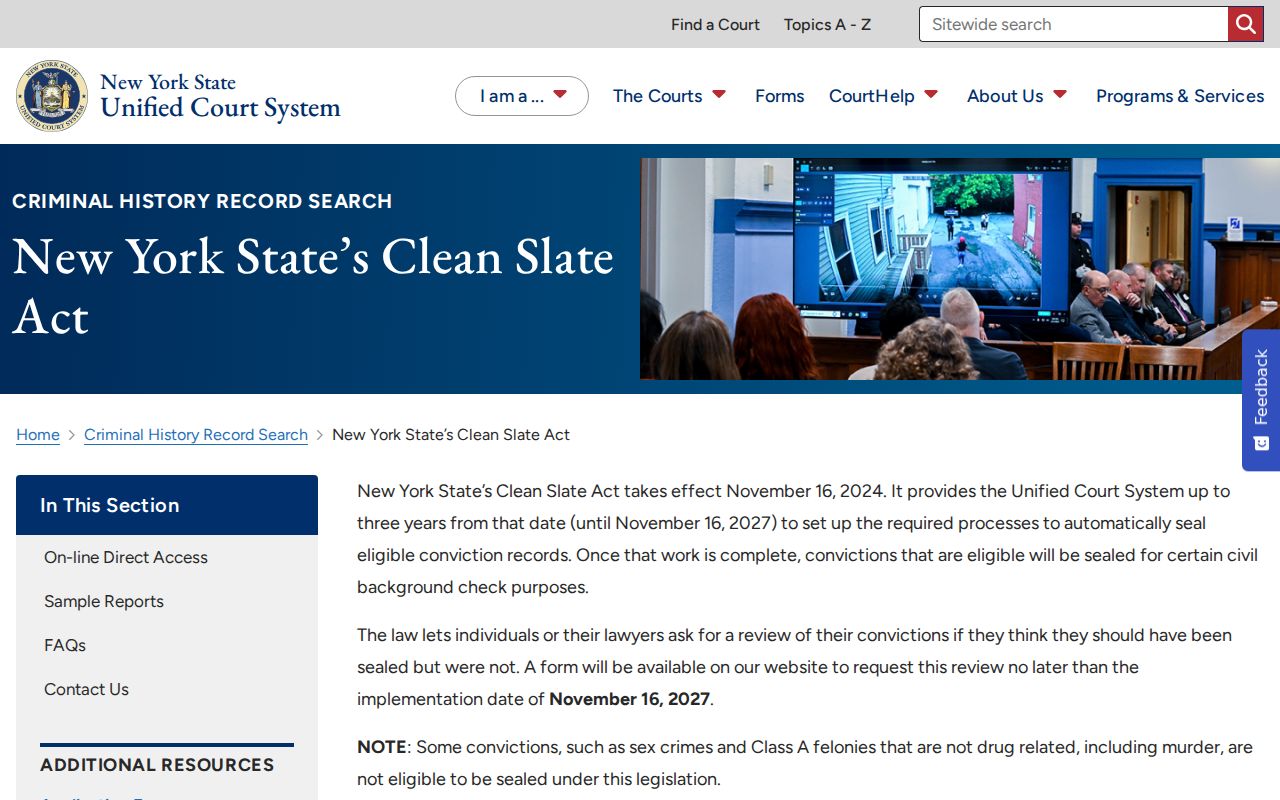
Public searches exclude sealed cases, while an unsuppressed self-review may display material that the subject is entitled to inspect.
Kings County Records Reflect Brooklyn Scale
Brooklyn and Kings County cover the same 69.4 square miles of land. The 2020 Census counted 2,736,074 residents, and the 2025 estimate was 2,653,963. That scale helps explain 23 NYPD precincts, separate Brooklyn North and Brooklyn South patrol commands, centralized police records, and citywide jail placement. It also makes one boroughwide crime rate too coarse for a neighborhood conclusion.
Use official NYPD precinct CompStat reports with the stated week, year, and comparison period. NYC Open Data can support broader trend work, but an aggregate row is not a personal rap sheet and should not be used to infer an individual's history. The Kings County DA reported declines in shootings and serious index crime in 2024 and further preliminary declines in 2025. Those summaries describe defined periods, not a permanent level of personal risk.
Federal Records in Kings County
Federal criminal cases from Kings County are heard in the Eastern District of New York. The Theodore Roosevelt U.S. Courthouse sits at 225 Cadman Plaza East, close to the state-court cluster, but its records do not enter WebCriminal as state cases. PACER is the official federal docket system. The Bureau of Prisons locator handles federal custody, and an FBI Identity History Summary is a fingerprint-based subject-only product.
The Kings County District Attorney's official source shown below represents the state and local prosecution layer, not the federal court.
A search that stops with either the DA or EDNY may miss the other jurisdiction. Match the prosecuting authority and courthouse to the case caption before choosing a record system.
City-by-City Criminal Records in Kings County
Kings County has one qualifying city geography for this project. Brooklyn was consolidated into New York City in 1898 and is now coterminous with Kings County, so Williamsburg, Flatbush, and other neighborhoods are not separate cities. The local page explains how the NYPD's 23 precincts feed one citywide records process, why there is no independent Brooklyn police department or municipal court, and when a search field expects Kings instead of Brooklyn.
Brooklyn Record Check
2025 estimate: 2,653,963. Use NYPD, Kings Criminal Court, Supreme Criminal Term, and NYC DOC channels.